

Beyond the Numbers: Actuaries Rank Communication Skills as Top Value Driver
In a recent online poll, over 500 actuaries weighed in on a pivotal question: “What made you more valuable as an actuary?” The results provide a revealing look at the skill sets actuaries themselves believe drive their value. The findings might also surprise those who assume technical prowess always comes first. While deep analytical expertise remains crucial, actuaries are signalling that their human skills may matter just as much in today’s business world.
Survey Results: Communication Comes Out on Top
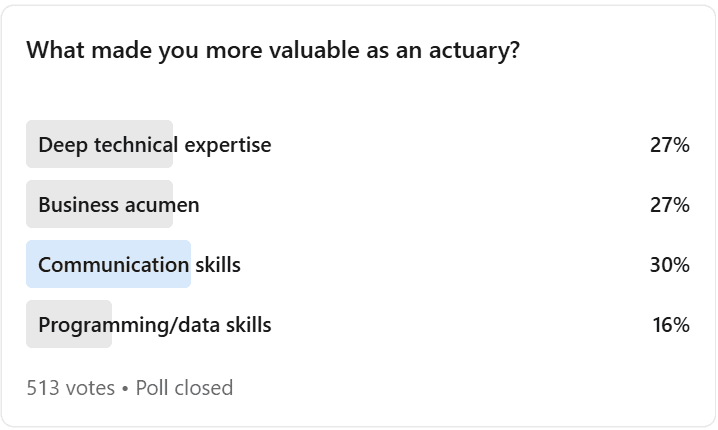
The survey attracted 513 responses, and the responses highlight four key areas that actuaries credit for increasing their value. As shown above, actuarial communication skills took the top spot with 30% of the vote, slightly ahead of deep technical expertise and business acumen (tied at 27% each). Programming/data skills were selected by 16% of respondents, important, but trailing the other categories.
In other words, a significant number of the actuaries that responded feel that being able to explain and contextualise complex work added more value to their careers than technical know-how alone.
Technical expertise and business acumen were not far behind in the poll. This suggests a well-rounded profile is key as successful actuaries marry analytical depth with a strong understanding of the business context.
Whilst the study did not control for stage of career (an important point), or other control variables, the relatively lower vote for programming skills (16%) might reflect that while data and coding proficiency are increasingly part of the actuary’s toolkit, they alone are not sufficient to stand out. Tools and programming languages such as Python and R are indeed changing the role for actuaries as many are learning these to analyse big data more efficiently, but on their own they’re not what most of the surveyed actuaries feel made them valuable. Instead, the poll indicates that actuaries see the greatest value-add coming from how they apply their technical skills in a broader business and interpersonal context.
Why These Skills Matter for the Actuarial Profession

These poll results carry potential implications for the actuarial profession as a whole. Actuaries have long been known for stellar quantitative abilities, but the profession’s evolution has been highlighting the need for softer skills and business insight. The fact that “communication skills” edged out the others in our poll sends a powerful message: being an effective actuary today is about more than mastering math. It’s about influence, understanding, and being heard. Actuaries are no exception to this trend as the ability to convey complex concepts in clear, relatable terms is now seen as a core competency for driving impact.
Equally, the strong showing for business acumen (27% of votes) highlights that actuarial work doesn’t happen in a vacuum. Actuaries add the most value when they understand the industry and commercial environment in which their models operate. An actuary who grasps the bigger picture can tailor their advice to align with strategic goals and foresee implications that purely technical analysts might miss. For example, pricing an insurance product isn’t just a mathematical exercise, it requires understanding customer needs, competitive pressures, and regulatory constraints. Actuaries who are business savvy can bridge the gap between technical results and strategic decision-making, earning them a trusted seat at the table.
Meanwhile, that deep technical expertise remains near the top of the poll (27%) is a testament to its enduring importance. The actuarial profession is built on rigorous analytical foundations, from mastery of probability to financial theory, and this expertise is still a huge part of an actuary’s value proposition. No amount of charm or business sense can replace the need to get the numbers right.
What the survey highlights, however, is that technical skill alone are not enough. The modern actuary is a hybrid: part mathematician, part business analyst, and part communicator. The days when an actuary could thrive by being a solitary technical genius are fading. In a fast-changing world of data and emerging risks, actuaries need to continually update their technical toolkit while also honing the skills that help deliver those technical insights to the wider world.
Finally, the lesser emphasis on programming and data skills in the poll results shouldn’t be mistaken for unimportance. In fact, many actuaries today are investing in data science knowledge and automation skills, recognising that efficiency and advanced analytics can amplify their impact. The survey results likely reflect that programming is often a means to an end, an enabling skill that supports the communication, analysis, and business understanding which ultimately drive value. An actuary who can code is certainly a valuable asset, especially early in their career, but an actuary who can code and explain the business impact of their analysis is the one who truly stands out.
What This Means for Employers of Actuaries

When actuaries themselves say that communication and business acumen made them more valuable, it highlights a shift in what organisations should prioritise when developing and evaluating actuarial talent. Here are a few implications for actuarial employers:
In essence, employers should strive to cultivate T-shaped actuaries – professionals with deep technical expertise (the vertical stroke of the “T”) and a broad set of cross-disciplinary skills (the horizontal stroke) like communication, business understanding, and leadership. Actuaries who fit this profile are more likely to drive projects forward, gain trust from stakeholders, and find creative solutions to complex problems. Organisations that recognise and nurture these qualities will not only get more value from their actuarial teams but also find it easier to attract forward-thinking actuarial talent in a competitive actuarial job market.
What This Means for Early-Career Actuaries
For actuarial students, actuarial exam-takers, and those in the early stages of their careers, the survey offers a clear message: to maximise your impact and career growth, focus on more than just the exams and technical skills. Technical mastery will get you in the door (and you should absolutely build a strong foundation there) but the qualities that will set you apart over time are often those beyond the textbook. In other words, aim to become a well-rounded actuary with a toolkit that spans communication, analytics, and business knowledge. Here are some practical takeaways for those starting out:
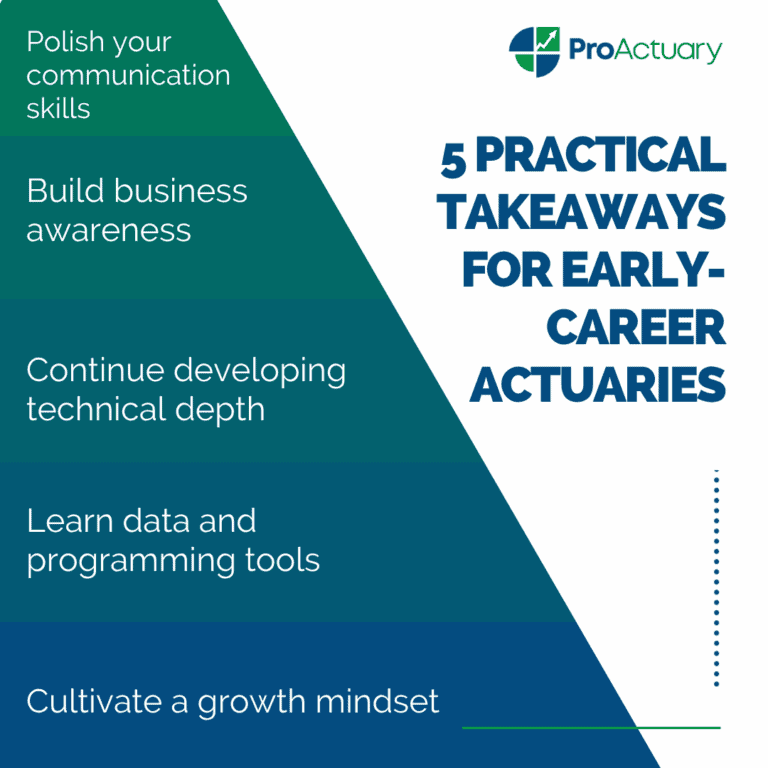
For young professionals, the takeaway is empowering: you have control over developing these high-impact skills. You can work on being a better communicator and a more business-savvy thinker in parallel with passing exams. Doing so will not only make you more effective in your current role but also open up opportunities for leadership and innovation down the line. The actuaries who rise fastest often combine credibility in the numbers with the ability to inspire confidence and drive action through their insights.
In conclusion, the message is clear: being a valuable actuary today isn’t just about what you know, it’s about what you do with what you know. And how you convey it. Communication skills, deep expertise, business savviness, and programming ability are all pieces of the puzzle.
For actuaries and those who work with them, the challenge and opportunity lie in putting those pieces together. The result, as evidenced by both the survey and real-world experience, is an actuary who doesn’t just calculate risk, but confidently guides stakeholders through it. Such actuaries will lead the profession into the future, proving that the most valuable professionals are those who can speak the language of both numbers and people. The actuarial future looks bright for those who embrace this holistic skill set.